Home / Mendix Opcenter MES
MES Low-Code Customization

Build Custom MES Solutions with Mendix + Opcenter

Create scalable, role-based manufacturing applications faster with low-code personalization inside Siemens Opcenter Execution.

Opcenter is never modified. Apps read and write production data through published interfaces; orders, routings and genealogy stay where they are.

250+
AI certified developers
90-day
Typical delivery
12+
Industries served
3
Global delivery hubs
Quick answer

Mendix Opcenter MES customization means building role-specific manufacturing applications on top of Siemens Opcenter Execution using Mendix low-code. Operators, supervisors, and quality teams get purpose-built interfaces and workflows, integrated with ERP, PLM, and machine-level systems, while the Opcenter backend stays unchanged.

Key facts
  • ✓ Siemens Opcenter is a manufacturing execution system; Mendix is the Siemens low-code application platform used here to personalize and extend Opcenter rather than replace it
  • ✓ The front-end user experience is personalized without changing the Opcenter backend, so existing systems aren't disrupted and operators need no retraining on the core MES
  • ✓ Applications are built with Mendix Marketplace content, including the Opcenter Execution Starter Kit, Workflow Commons, and Atlas UI Resources
  • ✓ Opcenter connects to ERP such as SAP, PLM including Teamcenter, sensors, IoT systems, and legacy applications through APIs, connectors, and standard protocols
Use Cases

What you can do with Mendix and Opcenter

These low-code MES solutions are designed using proven Siemens technologies. Each app is built to fit your plant's specific needs—with real-time data, seamless integration, and minimal disruption.

  • ✓Build task-specific UIs for operators, supervisors, and quality teams
  • ✓Integrate Opcenter with ERP, PLM, and machine-level systems
  • ✓Monitor production KPIs with live dashboards
  • ✓Automate shopfloor workflows and approval cycles
  • ✓Scale across plants with reusable templates
What is Mendix for Opcenter?
The Benefits

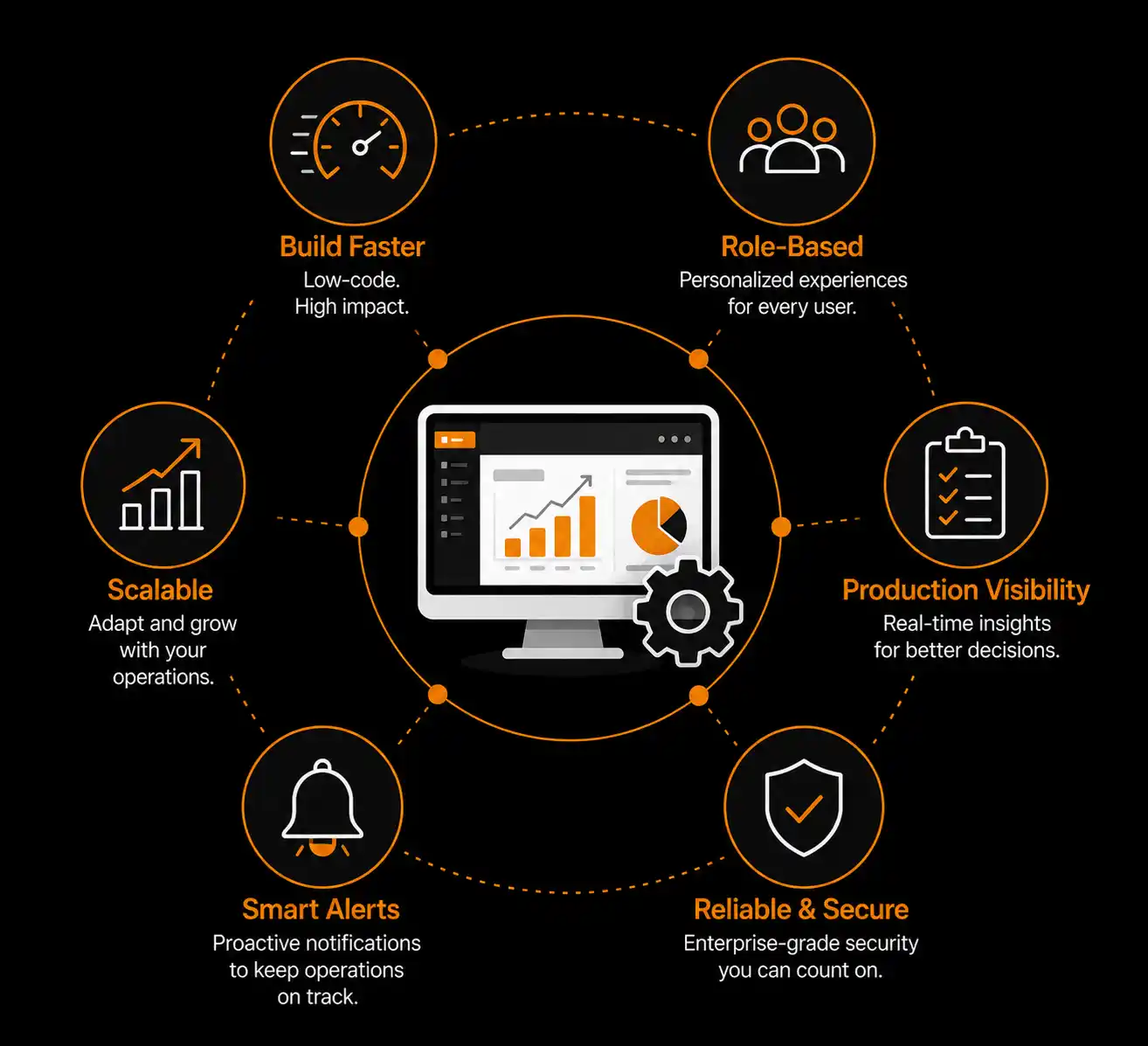
Why manufacturers choose Mendix for Opcenter

Faster Development

Faster Development

Low-code lets you build and deploy MES extensions in weeks, not months.

AI-Driven Enhancements

AI-Driven Enhancements

Integrate computer vision, predictive models, and intelligent rules easily.

Adaptable Solutions

Adaptable Solutions

Use prebuilt templates for discrete and process industries—or create your own.

Enterprise Integration

Enterprise Integration

Connect to SAP, Teamcenter, sensors, or legacy systems with ready-to-use connectors.

Transformation

Shopfloor transformation with Mendix + Opcenter

Leading manufacturers are modernizing their MES environments with Mendix embedded in Siemens Opcenter. By personalizing the front-end user experience without changing the backend, they're improving performance and accelerating delivery.

Benefits:

  • ✓Up to 30% reduction in development effort
  • ✓Role-based, intuitive user interfaces for operators and supervisors
  • ✓No disruptions to existing systems or retraining required
  • ✓Faster deployment with scalable low-code applications

Mendix helps manufacturers deliver customized MES solutions that are efficient, maintainable, and built to scale.

What is Mendix for Opcenter?
The Toolkit

Mendix tools for Opcenter MES customization

Speed up development with prebuilt templates and components available on the Mendix Marketplace. These tools help you build scalable, user-friendly Opcenter MES solutions faster.

Opcenter Execution Starter Kit

Use AI to forecast equipment failures and reduce unplanned downtime.

Workflow Commons

Add customizable task flows and approval processes to your Opcenter apps.

Atlas UI Resources

Guide technicians with AI-based steps to speed up issue resolution.

FAQ

Frequently asked questions

What is Mendix for Opcenter?

Mendix is the Siemens low-code platform. Used with Siemens Opcenter, it lets you build and customize MES applications faster and with less code than traditional Opcenter customization. The applications sit on top of Opcenter and personalize the user experience without changing the backend.

How does it work?

Mendix applications are embedded alongside Siemens Opcenter Execution and read and write MES data through APIs and connectors. You build role-specific screens and workflows visually, using Marketplace starter content, then deploy to cloud, hybrid, or on-premises environments.

What can I build on top of Opcenter?

Operator dashboards, quality tracking applications, mobile task workflows, custom user interfaces for production lines, and KPI monitoring tools. In practice, most first projects replace a paper register or spreadsheet process that sits beside the MES rather than inside it.

What are the business benefits?

MES extensions delivered in weeks rather than months, no disruption to existing systems, no retraining on the core MES, role-based interfaces that reduce onboarding time for new operators, and reusable templates that make each additional plant cheaper than the first.

Who typically needs this?

Plant and manufacturing IT teams carrying a backlog of shop floor requests, operations leaders whose processes still run on registers or spreadsheets beside the MES, and manufacturers standardizing Opcenter across multiple sites.

Which industries use Mendix with Opcenter?

Discrete and process manufacturing, with prebuilt templates covering both. Common applications include automotive and auto component line-side interfaces, electronics traceability and inspection, and production monitoring on EV and battery lines.

What technologies and systems are supported?

Siemens Opcenter Execution as the MES, Mendix as the application platform, and Marketplace content including the Opcenter Execution Starter Kit, Workflow Commons, and Atlas UI Resources. Integration is supported with ERP, PLM, IoT, sensors, and legacy systems.

How does implementation work?

Integration scope and Opcenter environment access are confirmed first, since that usually drives the timeline more than screen count. The application is then built using Marketplace starter content and Mendix visual development, and most reach a usable version in weeks rather than months.

How does it integrate with our ERP and PLM systems?

Through APIs, connectors, and standard protocols. Mendix connects to ERP systems such as SAP, PLM including Siemens Teamcenter, and IoT and machine-level systems, so a shop floor screen can carry the order, material, and product context an operator needs.

Is it scalable across multiple plants?

Yes. Applications are built with reusable templates so the same solution can be deployed and adapted per site rather than rebuilt. For manufacturers running plants across several states, this is usually what makes standardization commercially viable.

Is it suitable for Indian enterprises operating under global MES governance?

Yes, and this is one of the strongest reasons to take this approach. Where an Indian plant runs Opcenter under a global parent's licence and configuration, the backend often cannot be modified locally. Building in the Mendix application layer leaves the global setup untouched while giving local teams the workflows they need.

Can operator screens be delivered in regional languages?

Yes. Because the interface is built in Mendix rather than inside the MES, screens, prompts and work instructions can be delivered in the language a particular line uses, without altering the Opcenter backend that the rest of the enterprise depends on.

Get Started

Fast-track your Opcenter customization

Tell us which shop floor process is still running on paper, registers, or a spreadsheet beside the MES. We will scope a Mendix application against your Opcenter environment and give you a realistic view of integration effort, timeline, and how the work would be delivered.

What you get — free
  • ✓ Opcenter integration assessment
  • ✓ Feasibility & architecture review
  • ✓ Fixed-scope timeline & estimate
Schedule a Consultation →
Response within 24 hours
Automotive•Electronics•EV & Battery•Discrete Manufacturing•Process Manufacturing•Industrial Machinery•Aerospace•Medical Devices•

Register

Select The Country Code