
Mendix n8n AI Integration: Automate Sprint Planning Without a Custom Backend
The Monday Morning Problem: Sprint Planning Still Starts Too Late
Every software project begins with a Business Requirement Document. Sometimes it is 20 pages. Sometimes it is 60. But the process is usually the same — a developer or analyst reads through the document, highlights the key requirements, identifies modules, and manually converts business language into sprint-ready tasks. By the time the planning is complete, one or two working days are already gone. BRDs contain everything development teams need: workflows, business rules, validations, integrations, user conditions, and exception logic. Yet before a single Mendix microflow is built, teams spend hours manually extracting this information. The problem was not missing information. The problem was the time required to make that information actionable.
That challenge led us to build a smarter solution — a Mendix application connected to an n8n AI agent that reads a BRD and returns a structured sprint plan in under seconds.
Why Traditional BRD Review Cannot Keep Pace With Agile Delivery
In many enterprise projects, BRD analysis still depends on:
-
reading long requirement documents line by line
-
multiple clarification meetings
-
manually building sprint task sheets
-
writing user stories from scratch
-
repeated back-and-forth between business analysts and developers
The larger the BRD, the more planning overhead it creates.
Instead of accelerating delivery, teams spend valuable sprint time extracting information that already exists inside the document. This results in delayed sprint readiness, slower handoffs, inconsistent requirement interpretation, and reduced developer productivity.
Requirement understanding should support agile speed — not slow it down.
Why n8n Changed the Mendix AI Integration Equation
Most teams solving this kind of AI document analysis problem use a custom Python backend connected to an LLM API. While that works, it also introduces infrastructure setup, deployment pipelines, environment management, and ongoing maintenance. n8n offered a simpler alternative.
As a visual workflow automation platform, n8n allows AI agents to be built by connecting nodes for:
-
file parsing
-
AI prompt execution
-
JSON response formatting
-
webhook handling
without writing custom backend glue code.
More importantly, every n8n workflow can be exposed as a webhook endpoint. For Mendix, this becomes a clean and highly maintainable integration point.
Mendix manages the UI, domain model, and file handling. n8n manages AI orchestration, document understanding, and response formatting.
The result is a complete AI workflow with no custom API server to maintain.
How the Mendix n8n AI Sprint Planning Workflow Functions
The user-facing process is simple, but the backend automation is highly effective.
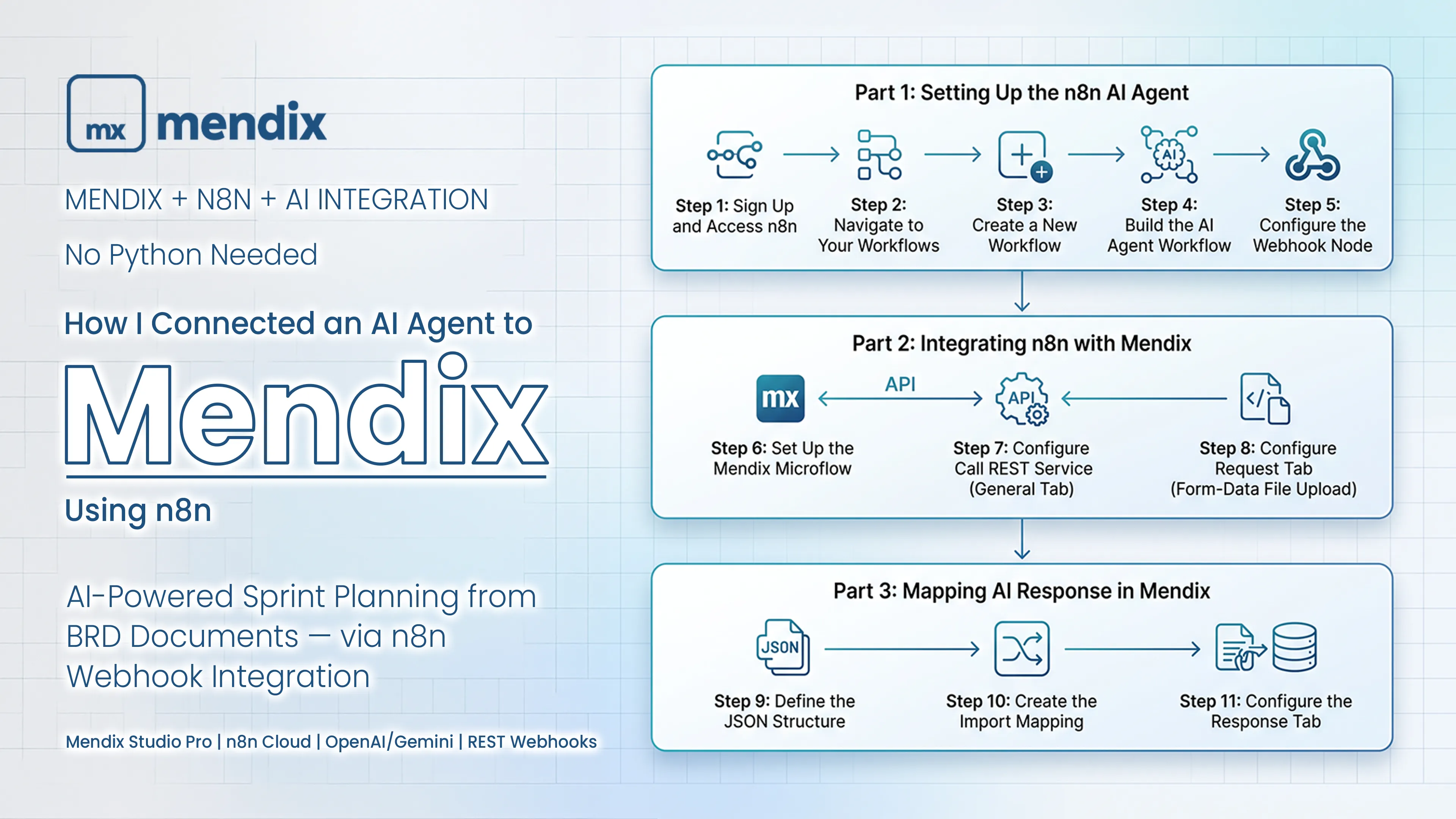
BRD Upload Through the Mendix Application
A business analyst or developer uploads the BRD file through the Mendix interface. The file can be PDF, DOCX, or any text-based requirement format.
Mendix Microflow Fires a POST Request to n8n Webhook
Once uploaded, a Mendix microflow captures the file and sends it as multipart form-data to the n8n webhook endpoint using Mendix’s native REST call activity.
This requires no custom backend code.
n8n AI Agent Reads and Interprets the Document
Inside the n8n workflow:
-
the document text is extracted,
-
the AI node processes business logic,
-
functional modules are identified,
-
user actions are interpreted,
-
validation rules are analyzed,
-
and sprint planning tasks are generated.
The intelligence lies in the AI prompt and output formatting rather than heavy backend engineering.
Structured Sprint Planning Output Mapped Back into Mendix
The n8n AI agent returns a clean JSON response containing:
-
business explanation
-
structured sprint plan
-
user stories
-
development task suggestions
-
acceptance criteria
Mendix maps this JSON directly into the domain model through import mapping, making the sprint plan instantly available inside the application dashboard.
This complete webhook-based AI integration can reduce hours of manual BRD analysis into a process completed in under 10 seconds.
Webhook-first automation patterns like this are one reason n8n has become increasingly popular for AI agent orchestration across enterprise workflows.
More Than a Summary: AI-Generated Sprint Planning Assets
This workflow does not generate a plain document summary.
It creates execution-ready planning outputs that teams can directly use during sprint preparation.
Functional Scope
Software modules and business features required for implementation.
User Story Candidates
Backlog-ready user stories framed around business outcomes.
Development Task Suggestions
Likely Mendix microflows, integrations, validations, and configuration activities.
Acceptance Criteria
Testing checkpoints that QA teams can directly use. The BRD stops being just a reference file and becomes a machine-processed sprint planning input.
What Actually Changes for Development Teams
Sprint planning that once consumed half a day now happens before the first standup.
Teams no longer begin by asking:
“What do we need to build?”
They begin by validating:
“Does this generated plan align with business expectations?”
That shift matters because AI handles information extraction while teams focus on judgment and execution.
Organizations gain:
-
reduced manual analyst effort
-
consistent planning structures across projects
-
faster BA to developer handoff
-
better sprint standardization
-
higher delivery productivity
Beyond BRD Analysis: The Broader Mendix n8n AI Automation Pattern
Sprint planning is only one-use case.
AThe same Mendix + n8n AI pattern can automate:
-
contract review and clause extraction
-
SOP interpretation
-
compliance checklist generation
-
onboarding document validation
-
meeting note summarization
-
invoice processing
-
Technical Specification breakdown
This reflects a broader shift in enterprise application development where Mendix acts as the business application layer and n8n handles intelligent AI orchestration.
Why Mendix Is the Right Foundation for This AI Workflow
Mendix significantly accelerates this implementation because it already provides:
-
secure file upload handling
-
rapid low-code UI creation
-
microflow-based REST automation
-
native JSON import mapping
-
role-based security
-
scalable deployment
Instead of building a full frontend and orchestration engine from scratch, development teams focus only on AI output logic and business workflow design.
This creates a highly practical low-code AI automation model.
Conclusion: Faster Planning Starts Before Development Starts
Software delivery delays often begin with document understanding, not coding.
When Business Requirement Documents remain trapped inside static files, sprint planning becomes slower and heavily dependent on manual extraction effort.
By connecting Mendix to an n8n AI agent through webhook integration, organizations can convert lengthy BRDs into sprint-ready execution plans within seconds — without maintaining a custom backend.