
AI Integration in Mendix: Automating BRD Analysis and Sprint Planning for Faster Delivery
Introduction: Why Sprint Planning Still Starts with Manual Document Reading
Agile development helps teams deliver applications faster, but one major delay still happens before development begins — manual requirement analysis.
Business Requirement Documents usually contain workflows, business logic, validations, exception cases, user actions, and integration requirements. Before developers start building Mendix pages or microflows, teams spend hours reading these documents, extracting functional scope, and converting business details into sprint tasks.
This creates an unnecessary planning bottleneck.
When one or two days are spent only understanding BRDs, sprint execution starts late and actual development time gets reduced. As enterprise teams push for faster software delivery, manual BRD interpretation is no longer an efficient approach.
The Growing Challenge of Manual BRD Analysis in Agile Projects
In many organizations, Business Requirement Document review still depends on :
-
manual document reading
-
multiple clarification meetings
-
writing user stories from scratch
-
manually preparing sprint task sheets
-
separate acceptance criteria documentation
-
repeated BA and developer discussions
The larger the BRD, the more planning effort it creates.
Instead of helping sprint readiness, teams spend valuable hours extracting information that already exists inside the document. This leads to delayed sprint planning, inconsistent requirement understanding, and reduced developer productivity.
How AI Integration in Mendix Changes Requirement Processing
Mendix already supports workflow automation, file handling, REST integrations, business logic, and scalable enterprise UI creation. This makes it an ideal low-code platform for AI-powered document analysis.
With AI integration in Mendix, BRD review no longer needs to stay manual.
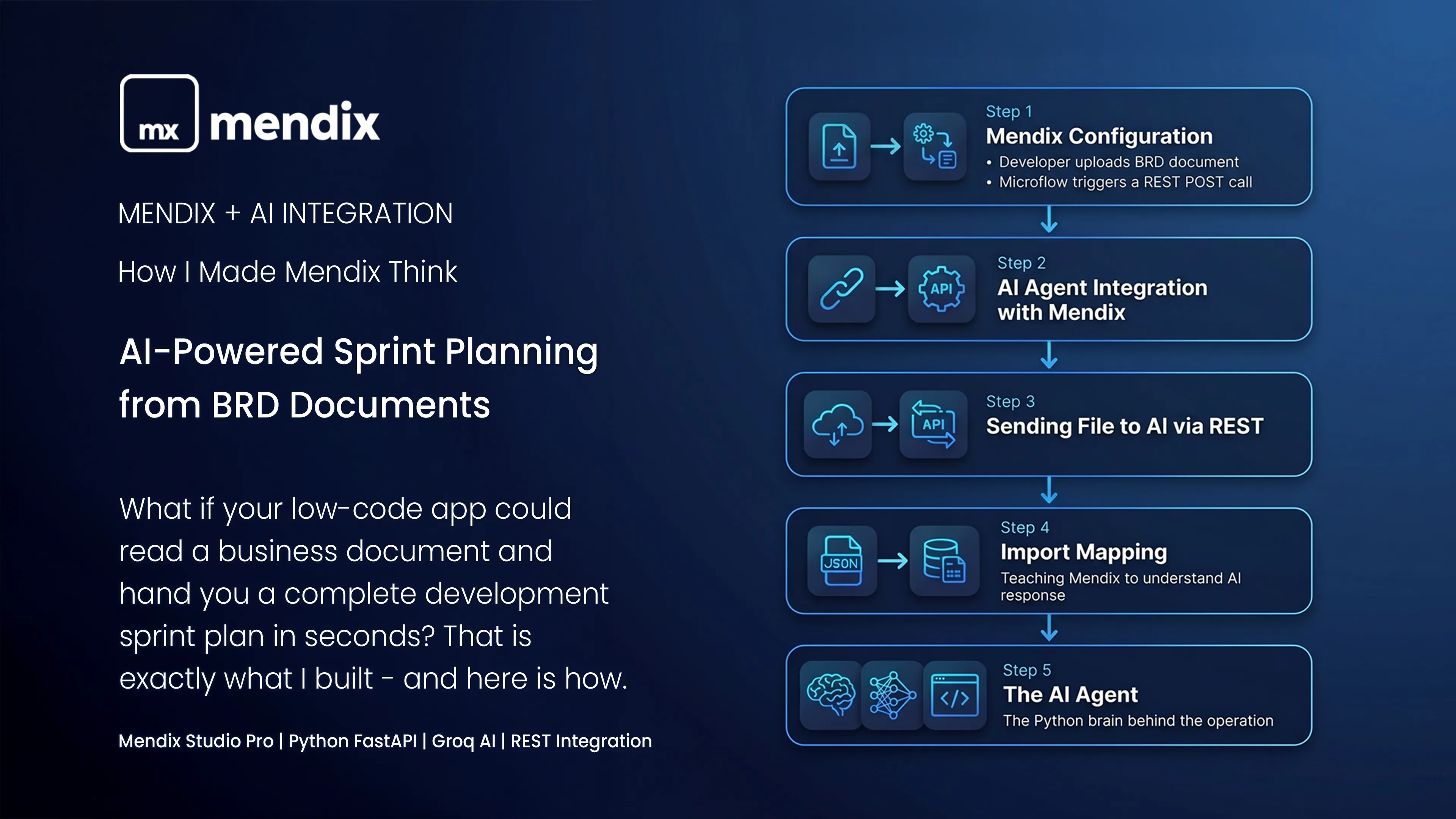
Users simply upload a Business Requirement Document through a Mendix application. The platform automatically sends the file to an external AI analysis engine that reads the document, understands business intent, identifies functional modules, and converts the content into structured sprint planning outputs.
This transforms Mendix into an intelligent requirement processing layer rather than just a development platform.
How the Mendix AI Sprint Planning Workflow Functions
The workflow is simple for users but highly effective in execution.
Upload BRD Through Mendix Application
A business analyst or developer uploads the BRD file through the Mendix application interface.
Mendix Microflow Sends File to External AI Engine
A Mendix microflow captures the uploaded document and sends it through REST API to an external Python FastAPI service.
AI Reads Functional Requirements and Business Logic
The AI engine processes:
-
business workflows
-
user interactions
-
validations
-
Dependency Conditions
-
exception scenarios
-
integrations
-
functional modules
Structured Sprint Planning Output Returned to Mendix
After processing, the AI returns:
-
simplified business explanation
-
user stories
-
sprint modules
-
development tasks
-
acceptance criteria
Mendix maps this response into a clean dashboard so development teams can begin sprint planning almost immediately.
This complete AI integration in Mendix reduces hours of manual document analysis into a workflow completed within seconds.
More Than a Summary: AI-Generated Development Planning Assets
This is not just a document summary tool.
The application generates execution-focused planning outputs that software teams can directly use.
Instead of simply describing the BRD, the AI identifies:
Functional Scope
The business modules and features required for implementation.
User Story Candidates
Potential backlog-ready user stories.
Technical Task Suggestions
Likely development tasks, validations, integrations, and configurations.
Acceptance Criteria
Testing and validation points for QA and business users. The BRD becomes a machine-processed sprint preparation input, making planning faster and more consistent.
Why Mendix Is the Right Low-Code Platform for AI Workflow Automation
Mendix significantly reduces implementation effort because it already provides:
-
secure file upload handling
-
rapid low-code UI development
-
microflow-based automation
-
REST API integration support
-
JSON response mapping
-
role-based access control
-
enterprise scalability
Instead of building every orchestration layer from scratch, teams can focus mainly on AI logic and business outcomes.
This creates a strong low-code and AI automation advantage for enterprises handling document-heavy planning workflows.
Business Benefits of AI-Powered Sprint Planning in Mendix
Organizations implementing AI integration in Mendix can achieve :
-
faster sprint planning readiness
-
reduced manual analyst effort
-
improved requirement consistency
-
quicker BA to development handoff
-
structured QA acceptance preparation
-
Planning standardization
-
higher developer productivity
Most importantly, development teams spend less time reading and more time building.
Beyond Sprint Planning: Other Mendix AI Document Automation Use Cases
The same Mendix AI architecture can also support :
-
contract review automation
-
SOP interpretation
-
compliance checklist extraction
-
customer onboarding validation
-
meeting note summarization
-
technical specification breakdown
This shows how Mendix is increasingly becoming an AI workflow orchestration layer for intelligent enterprise automation.
Conclusion: Smarter Sprint Readiness with Mendix AI Integration
Software delivery delays do not always begin in coding. In many projects, they begin in document understanding.
When business requirements remain locked inside static BRD files, sprint planning becomes slower and heavily dependent on manual extraction effort.
By implementing AI integration in Mendix, organizations can convert lengthy Business Requirement Documents into sprint-ready execution plans within seconds.
At MXTechies, we build practical Mendix AI integrations that transform manual business workflows into intelligent low-code automation systems, helping enterprises accelerate software delivery with less operational friction.